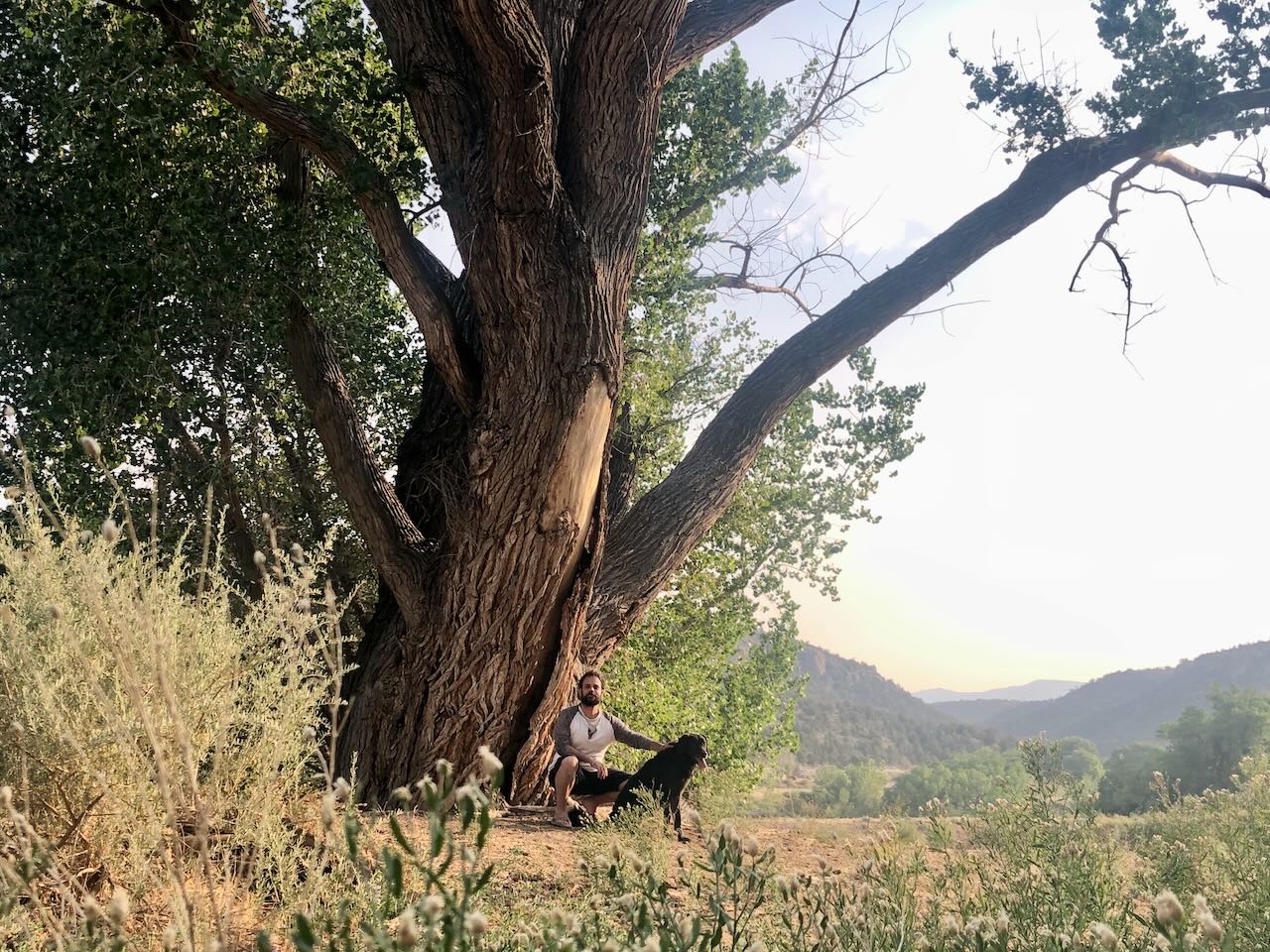
Hi There 👋🏼
I’m a self-taught software engineer and a generalist by temperament. I was born in Israel, lived in Germany, the Netherlands, and New York City, and these days I live in the Catskills.
I tend to follow problems until they require a different language, medium, or level of abstraction. That has taken me from music and interactive systems into native mobile software, SDKs, full-stack products, distributed systems, cryptography, protocol infrastructure, and lately into practical work with coding agents and AI-assisted engineering workflows. I do not see those as separate careers so much as different ways of working with computation.
Programming first made sense to me through jazz guitar, electroacoustic music, and real-time composition. At the Institute of Sonology in The Hague I spent time with SuperCollider, Pure Data, Lisp, Smalltalk, DSP, and interactive systems. I was not thinking about a software career then. I was trying to understand computation as an expressive material: something that could listen, react, generate structure, and extend what a person could do.
That beginning still shapes how I approach engineering. I like systems where constraints are explicit enough to make reliable work possible, but expressive enough to leave room for judgment. Before and during the early part of my engineering career, I also mentored, gave talks, and taught interactive digital art and media technology. Native mobile development gave me another version of the same problem: graphics, animation, touch, performance, memory, unreliable networks, and users who do not care how elegant the code is if the product feels wrong. Objective-C, Swift, C, C++, SDK work, React Native, and backend systems all became useful because the work demanded them.
Looking back, many of the problems that held my attention had a common shape. I kept returning to user agency, ownership, privacy, data sovereignty, inspectable systems, and trust that can be reasoned about instead of only assumed. I did not have that language at the beginning. It became clearer through open-source communities, through technical arguments that had to survive public scrutiny, and through working on systems where vague ownership or hidden assumptions eventually become production problems.
Open source matters to me for that reason. Not just because code is visible, but because the best open technical cultures reward reasoning over title. A serious disagreement about an interface, an invariant, or a protocol assumption can be uncomfortable, but when it is grounded in the system it is often how the work gets better.
Crypto became relevant to me through those older concerns, not as a sudden conversion. DaoStack was an early Web3 chapter where I worked on decentralized collaboration, fundraising systems, full-stack Web3 development, and protocol-oriented product thinking. It gave me practical contact with questions I had already been circling: who controls the data, who can change the rules, what is enforceable, and what has to be trusted socially.
At Holonym, now Human.tech, those questions became much more concrete. I worked on zero-knowledge identity and helped translate advanced cryptographic components into usable product infrastructure. That included Circom witness generation, rapidsnark/Groth16 proving, ZoKrates, Rust, TypeScript, React Native, Expo native modules, and secure MPC-related work, but the important lesson was not the tool list. It was learning how privacy, identity, and data sovereignty depend on small implementation details being connected to the product people actually use.
At Osmosis, I worked closer to account and wallet architecture. That included smart accounts, onchain WebAuthn registration, MPC wallet research, frontend/backend boundaries, product requirements, protocol constraints, mentoring, and production implementation. I cared about the whole path from a user’s account experience down to the assumptions the protocol could safely enforce.
At Nine Realms, my work has moved further into THORChain architecture, protocol security, ThorSec, validator and protocol infrastructure, cross-chain integrations, and institutional digital-asset infrastructure. That has included evaluating threshold signing and custody models, Bitcoin infrastructure, Router v6 and memoless transaction work, and architecture for Bitcoin-backed collateral through Canton and DAML. This is a different environment from consumer wallets, but the common thread is still the same: how to make coordination between people, software, institutions, and protocols more explicit and reliable.
A lot of my current attention goes into AI-assisted engineering. I do not think of this as a separate identity. It feels like another continuation of expressive computing, abstraction, delegation, and trust. I work with coding agents, evaluation loops, structured prompts, autonomous research patterns, evidence-grounded synthesis, and artifact-driven workflows. The interesting question for me is not whether an agent can produce code once. It is whether delegated work can be constrained, inspected, corrected, and reviewed by the human who remains responsible for the result.
The collaborations I value tend to have direct, technically substantive communication. I like working with people who care about the actual problem more than the preferred stack, who can move between product and implementation without losing precision, and who are willing to make assumptions explicit. I often notice gaps in interfaces, ownership, and system boundaries. Sometimes that makes me slow down before others want to, but usually it is because I am trying to understand where the work can fail.
I still play guitar, and I practice yoga. Both remind me that attention is practical, not decorative. Engineering has taught me something similar: the best work often comes from staying close enough to the details to be honest, while keeping enough distance to see the shape of the system.
Thank you for spending a bit of your time here.